


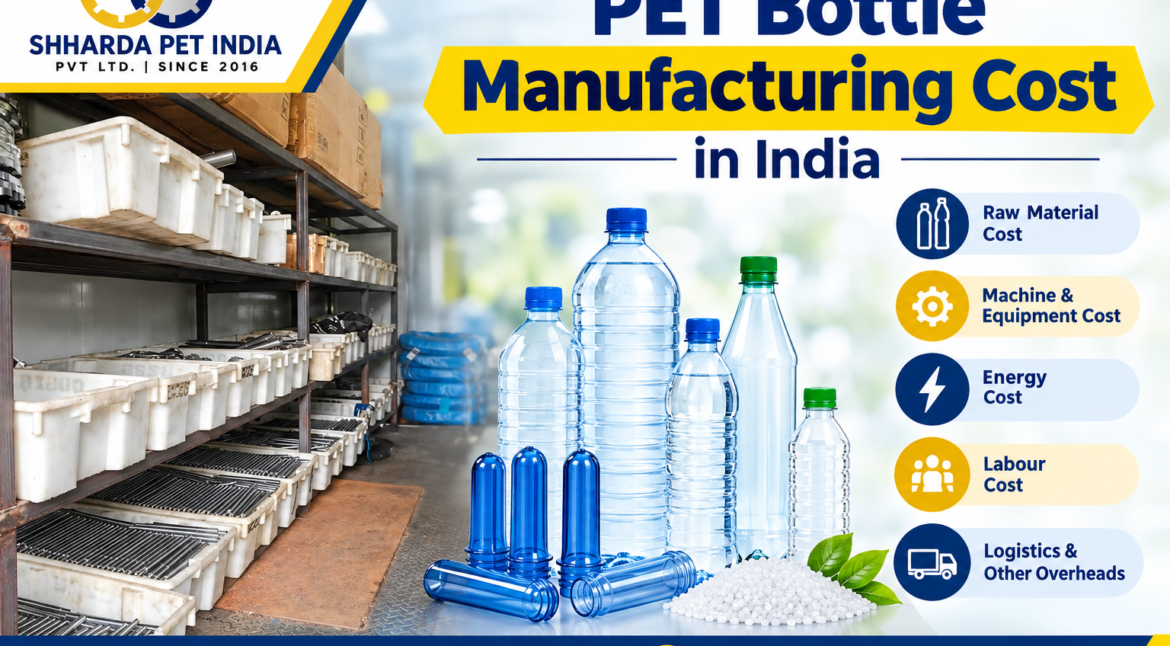
PET Bottle Manufacturing Cost in India: Key Factors Explained
- Home
- Molding Machine
- PET Bottle Manufacturing Cost in India: Key Factors Explained
Buyers across beverage, pharma, personal care, and home care brands often ask why quotes for similar containers differ so much. The answer lies in a handful of cost drivers that stack up from resin purchase to final delivery. Understanding how a PET bottle in India is priced helps procurement teams compare offers fairly and avoid surprises after the first order. This article explains each cost layer in plain terms, covering materials, processes, machinery, compliance, and logistics. Exact rupee figures change with market conditions, so the focus here is on pricing logic.
What Determines the Price of PET Packaging?

Price rarely comes down to one factor. Manufacturers add up several cost blocks and then spread them across the order quantity.
The main blocks are:
- Raw material cost, which usually forms the largest share of the final price
- Conversion costs, meaning energy, labour and machine time
- Mould and die investment, which is spread over the production run
- Quality checks and compliance, including testing and documentation
- Freight and handling, which depend on distance and bottle volume
- Manufacturer’s margin, which reflects service level and consistency
Each block responds differently to order size. Material cost scales almost directly with weight, while mold cost shrinks per unit as volume grows.
Which Raw Materials Shape the Cost?
The base material is polyethylene terephthalate, a clear and lightweight polyester known for strength and recyclability. Its price follows crude oil and petrochemical trends, so it moves up and down through the year.
Several material choices affect the final number:
- Virgin resin gives the highest clarity and is the standard for food and pharma contact
- Recycled content (rPET) can lower material cost, though food-grade approval adds checks
- Colour masterbatch adds cost for tinted or opaque bottles
- Barrier additives protect oxygen-sensitive contents such as juices and certain oils
- UV blockers are used where light exposure spoils the product
A plain clear bottle sits at the lower end of the price range. Every added property pushes the cost up in small steps.
How Does the Manufacturing Process Affect Pricing?
A container starts as a small, test-tube-shaped piece called a preform. The preform is heated and stretched into the final shape using stretch blow moulding, a method that runs on a fully electric, high-speed blowing machine in large plants. This two-step method is common because it produces strong, clear walls with consistent thickness.
There are two production routes:
- Two-stage process: preforms are made first, stored or shipped, then blown into bottles on a separate machine. It suits manufacturers who supply preforms to other bottlers.
- Single-stage process: both steps happen on one machine. It saves handling but is used mostly for specialised shapes and smaller runs.
Cycle time matters here. A faster cycle means more bottles per hour, which reduces the conversion cost on each one. Energy use also counts, since heating and compressed air are major expenses on a factory floor.
Smaller producers often start with a semi-automatic blowing setup, which keeps the entry cost low while output stays modest.
Where Does Machinery and Mould Investment Fit In?

Every PET bottle in India carries a share of the factory’s equipment cost. Injection machines, blow machines, chillers and air compressors represent a heavy upfront investment. A plant recovers this over years of production, so the cost is built into every unit price.
Preform quality starts at the injection stage. A modern preform injection moulding machine with better cooling shortens cycle time, and that saving reaches the buyer through a steadier unit price.
Moulds deserve special attention. A multi-cavity mould produces many preforms per cycle and lowers the unit cost, but it costs more to make. A custom bottle shape needs its own blow mould, and that expense is usually shared across the first few orders or charged separately. Experienced makers of custom blow moulds can often adjust cooling design to bring cycle time down.
Standard shapes avoid this cost entirely because the mould already exists.
Why Do Size, Weight and Neck Finish Matter?
Larger bottles use more resin and take longer to cool, so they cost more. Weight is the clearest example. Two bottles of the same capacity can differ in price if one uses a thicker wall.
Neck finish is another quiet cost driver. The neck is the threaded top that receives the cap. Standard neck sizes work with widely available closures. Unusual neck designs need special preform moulds and matching caps, which raises both cost and lead time.
Closures also add to the total. Plants that produce their own caps on a rotary cap moulding line can control this cost better than those that buy them in.
Light-weighting is a growing trend. Brands now ask for thinner walls that still pass drop and pressure tests, saving material without hurting performance.
How Do Location and Logistics Influence Cost in India?
Geography plays a real role. Manufacturing clusters in Gujarat, Maharashtra, Tamil Nadu, Haryana and the Delhi NCR region benefit from nearby resin suppliers and strong transport links. Buyers close to these hubs often pay less for freight.
Empty bottles are bulky and light, so a truck fills up on volume long before it reaches weight limits. This makes transport expensive relative to product value. Preforms are far more compact, which is why many bottlers buy preforms and blow them in their own plant.
Other regional factors include:
- Power tariffs that differ from state to state
- Local taxes and applicable GST treatment
- Port access for exporters
- Lead times during festival and summer peaks, when beverage demand rises
Which Applications Need Which Bottle Type?
Different uses call for different specifications, and each has its own cost profile.
- Packaged drinking water: lightweight, clear, standard neck, high volume, lowest cost per unit
- Carbonated drinks: thicker base and wall to handle internal pressure
- Juices and hot-fill drinks: heat-set bottles that resist warping at high filling temperatures
- Edible oils: square or round shapes with grip handles and good clarity
- Pharma syrups: strict hygiene, tamper-evident closures and tighter inspection
- Cosmetics and home care: decorative shapes, coloured or frosted finishes, often custom moulds
Hot-fill and pharma containers cost more because of stricter production control and extra testing.
How Do Quality Standards and Compliance Add to Cost?
Food and pharma packaging must meet national safety rules. Manufacturers follow standards set by the country’s standards body and food contact requirements laid down by the food safety regulator. Meeting these rules requires clean production areas, trained staff, lab testing and proper records.
Common quality checks include:
- Wall thickness and weight consistency
- Top-load and burst strength
- Leak testing with the matching closure
- Migration testing for food contact safety
- Visual inspection for scratches, haze and black specks
These checks add to overhead, but they protect the brand from recalls and customer complaints. A very low quote sometimes means checks have been trimmed, which is a risk worth weighing.
Waste handling is another growing factor. Producers now face extended responsibility rules from pollution control authorities, and the cost of meeting recycling targets gradually shows up in pricing.
What Is the Cost Difference Between Stock and Custom Bottles?
Stock bottles use existing moulds. They ship quickly and carry no extra mould charge, so they suit startups and small batches.
Custom bottles offer a distinct shelf identity. The trade-off is a one-time mould expense, longer development time, and higher minimum order quantities. Brands usually choose custom designs once volumes justify the investment.
A useful middle path is to start with a stock shape and add custom labels, sleeves or coloured closures. This builds identity at a fraction of the cost.
How Can Buyers Compare Quotes Fairly?
Two quotes mean little unless the specifications match. Before comparing, confirm these points:
- Bottle weight in grams
- Resin grade and recycled content share
- Neck finish and closure compatibility
- Mould ownership and who pays for it
- Minimum order quantity and payment terms
- Packing method and delivery location
- Test reports and batch traceability
Asking for a sample run is a smart habit. Fill it, cap it, stack it, and ship it before approving a bulk order. Problems show up quickly under real handling conditions.
Conclusion
A well-priced container is one whose specification matches the product inside. Weigh resin grade, weight, neck design, compliance, and delivery together rather than chasing the lowest figure. Share your product type, volume, and target shelf life with a trusted manufacturer, request a sample run, and compare quotes on equal terms. When you are ready to talk specifications for a PET bottle in India, reach out to the team and get a plan built around your volume.
Frequently asked questions
Get In Touch
Fill all information details to consult with us to get services from us
Raw resin is the largest share. Its price depends on crude oil trends, supply and demand, and import conditions.
It can be, but food-grade recycled resin needs approval and extra processing, so the saving is not always large.
Machine setup, changeovers and mould recovery are spread over fewer units, so each unit carries a larger share.
Yes. Colour masterbatch and extra quality control for shade matching add cost compared with clear bottles.
Design approval, mould making and trial runs usually take several weeks, depending on the shape complexity.
It depends on the manufacturer and on whether the shape is stock or custom. Stock bottles usually have lower minimums. Custom designs need larger runs to justify the mould investment. Confirm the figure in writing before approving a quote.
PET is widely recyclable, and used bottles can be reprocessed into new containers, fibres and sheets. Quality drops gradually with each cycle. For food contact, recycled content is often blended with virgin resin to keep strength and clarity consistent.
PET is clear, rigid, and offers a good gas barrier, which suits water, juices, and soft drinks. HDPE is opaque or translucent and handles impact and chemical contact better, so it is common for milk, detergents, and agricultural products. HDPE containers are usually shaped through extrusion blow moulding, while PET relies on the stretch method. Price differences come from weight, wall thickness, and the production method.