


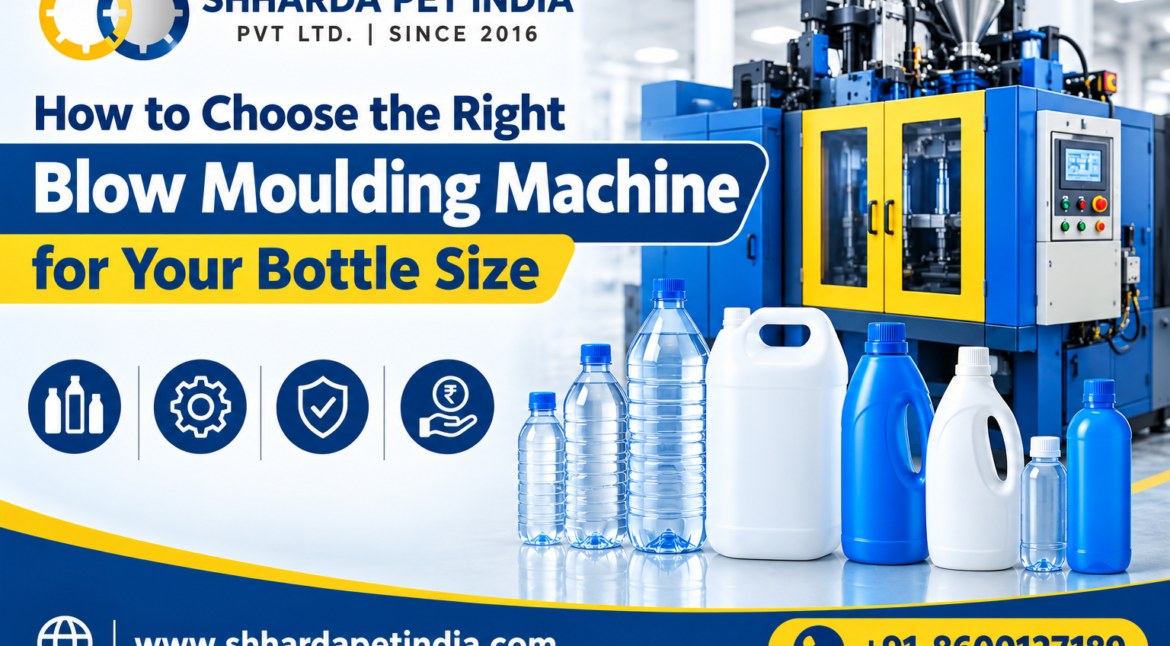
How to Choose the Right Blow Moulding Machine for Your Bottle Size
- Home
- Molding Machine
- How to Choose the Right Blow Moulding Machine for Your Bottle Size
A machine that blows 1,000 one-litre bottles an hour is the wrong purchase for someone who sells 20-litre water jars. The same goes the other way round. Most buying mistakes in PET bottle making come from matching a machine to a price tag instead of to a bottle size and a daily output number.
This guide walks you through a simple way to match a blow moulding machine to your bottle size, your output target and your budget. It is written for first-time buyers, so there is no jargon you will need to look up afterwards.

Why Bottle Size Decides Everything
PET bottles are made by stretch blow moulding. A small plastic tube called a preform is heated, stretched with a rod, and then blown with high-pressure air into a mould shaped like the final bottle.
Bottle size controls almost every machine decision that follows:
- Preform weight and size: a 200 ml bottle and a 20-litre jar start from very different preforms.
- Mould and clamping size: bigger bottles need larger moulds and more clamping force.
- Air pressure and volume: larger bottles consume more compressed air per cycle.
- Cycle time: bigger bottles take longer to blow and cool, so output per hour falls as size rises.
That last point surprises many buyers. A machine rated at several thousand bottles an hour is almost always rated for a small or mid-size bottle. Ask for the output at your bottle size, not the headline figure.
Common bottle sizes and where they are used
Here is how common sizes line up with real products you already see on shelves.
Bottle size | Typical use |
200 ml | Small packaged water packs (Bisleri sells 200 ml bottles in packs), juice and drink samples |
250 ml | Juice, soft drinks, hotel and event water |
500 ml | Everyday packaged water, soft drinks |
1 litre | Packaged drinking water, the most common size for small bottling plants |
2 litre and above | Soft drinks, family packs, edible oil, detergents |
20 litre | Water jars for homes and offices |
If you are comparing water bottle sizes, the small range (200 ml to 500 ml) suits retail and events, while the large range (1 litre to 20 litres) suits households, offices, and bulk supply.
Machine ranges also help you shortlist quickly. Indian manufacturers list PET stretch blow moulding machines covering roughly 50 ml to 20 litres, and some start at 100 ml. Always confirm the exact range for the specific model you are considering.
What about 15 ml to 30 ml bottles?
Sizes such as 15 ml, 20 ml, 25 ml, and 30 ml are common for pharma drops, essential oils, sample vials, and cosmetics. A 50 ml bottle size sits at the edge of what many PET stretch blow machines can handle.
Very small bottles often need special preforms, fine mould tooling and tight neck finishes. Some are made on other processes entirely. If your range sits below 50 ml, tell the manufacturer before you ask for a quote and request a trial run on your actual bottle.
Semi-Automatic vs Fully Automatic PET Blowing Machines
Your choice between these two types depends mostly on daily output and how many people you want on the floor.
Semi-automatic PET blowing machine
In a semi-automatic PET blowing machine, an operator loads preforms into the heater and moves them to the blowing station by hand. The machine then handles the stretch and blow.
- Best for: startups, pharma and cosmetic runs, jars, and frequent bottle changes
- Typical output: listings for semi-automatic preform machines covering 200 ml to 2,000 ml show about 1,000 bottles an hour
- Upside: lower upfront cost, simpler to maintain, easier to switch moulds
- Trade-off: needs more manual labour, and output depends on operator speed
Fully automatic PET bottle blowing machine
A fully automatic PET bottle blowing machine feeds preforms, heats them, blows the bottle and delivers it on a conveyor with no manual loading.
- Best for: packaged water, juice and soft drink lines running every day
- Typical output: a 2-cavity machine for 1-litre bottles is listed at around 4,000 bottles an hour
- Upside: consistent quality, lower labour cost per bottle, higher output
- Trade-off: higher investment, and it needs steady daily demand to pay back
Some manufacturers also offer features worth asking about, such as a battery backup that safely rejects bottles during a power cut, and hydraulic locking with a double pump for stronger clamping.
Step-by-Step: Choosing Your Machine
Follow these seven steps in order. Each one narrows your options.
- List every bottle size you plan to make. Write down the smallest and largest bottle in your plan, including future products. A machine that covers 200 ml to 2 litres will not run a 20-litre jar.
- Confirm the neck finish and preform. Check the neck diameter and preform weight for each bottle. These decide which preform you buy and which mould you need.
- Set your daily output target. Multiply your sales goal by your working hours. If you need 8,000 one-litre bottles in an 8-hour shift, you need at least 1,000 bottles an hour, plus a margin for stops and changeovers.
- Work out the cavities. Output per hour grows with the number of cavities in the mould. A 2-cavity machine makes two bottles per cycle, a 4-cavity machine makes four. Ask for output at your bottle size.
- Choose semi-automatic or fully automatic. Under about 1,000 bottles an hour or with many bottle changes, semi-automatic usually makes sense. Above that, or with one product running daily, go fully automatic.
- Check your utilities and floor space. You will need three-phase power, a high-pressure air compressor, a chiller for mould cooling and enough room for a conveyor if you choose automatic. Ask for the exact power load.
- Ask for a trial and a service plan. Request a sample run on your preform, and confirm spare-part supply and service coverage in your region.
Real-World Examples
A packaged water start-up making 1-litre and 500 ml bottles. The owner needs about 8,000 one-litre bottles a day. A semi-automatic machine at roughly 1,000 bottles an hour covers that in one shift, with little room for downtime. A fully automatic 2-cavity machine at around 4,000 an hour covers the same number in two hours and leaves room to grow.
A 20-litre jar supplier for offices. Output per hour is much lower on jars because each one is large and cools slowly. A semi-automatic jar machine is the common choice here, since demand is steady but volumes are modest.
A pharma syrup packer using 100 ml and 200 ml bottles. This buyer changes sizes often and runs short batches. A semi-automatic machine with quick mould changes is easier to manage than a high-speed line built for a single product.
An event water supplier using 200 ml and 250 ml bottles. Small bottles run fast, so a multi-cavity machine delivers good output, though the supplier must check that the machine’s smallest size covers 200 ml.
Mistakes to Avoid
- Buying on headline output alone. The advertised rate usually applies to one bottle size.
- Ignoring the bottle pull-out size. Check the maximum bottle height and diameter the mould can release, since this limits the largest bottle the machine can make.
- Skipping the air system. An undersized compressor causes weak bottles and rejects.
- Forgetting changeover time. Frequent size changes eat into hours, so ask how long a mould swap takes.
- Leaving out spare parts. A cheap machine with slow spares costs more in downtime than it saves.
Conclusion
Start with your bottle sizes, then your daily output, then the machine type. A semi-automatic PET blowing machine suits smaller volumes, frequent size changes, and jars, while a fully automatic PET bottle blowing machine suits steady daily production of one or two sizes. Before you buy, confirm the size range, output at your bottle size, utility needs, and service support.
Read More
PET Blowing Machine Manufacturers in Bangalore
Blow Moulding Machine Manufacturers in Pune
Frequently asked questions
Get In Touch
Fill all information details to consult with us to get services from us
It depends on the model. Many Indian PET stretch blow moulding machines cover about 50 ml to 20 litres, and some start at 100 ml. Always confirm the exact range, because a machine built for 200 ml to 2 litres cannot run a 20-litre jar.
For a 1-litre water bottle, a 2-cavity automatic machine is the common choice for steady daily production, with listed outputs around 4,000 bottles an hour. A semi-automatic machine at around 1,000 bottles an hour suits smaller businesses.
On a semi-automatic machine, the operator loads preforms and moves them to the blow station. A fully automatic machine does feeding, heating, blowing and delivery without manual handling. Automatic costs more but requires less labour per bottle.
Listings for semi-automatic preform machines covering 200 ml to 2,000 ml show about 1,000 bottles an hour. Real output depends on bottle size, cavities and how fast the operator loads preforms.
Usually yes, if both sizes fall within the machine’s range and share a compatible neck finish. You will need a separate mould for each size, and a mould change takes time, so ask the supplier how long it takes.
These sizes are below the range of many standard PET stretch blow machines, which often start at 50 ml or 100 ml. They may need special preforms and tooling, or a different process. Check with the manufacturer and request a trial.
It varies by model. Plan for the machine itself, a high-pressure air compressor, a chiller and, for automatic lines, a conveyor. Ask the supplier for the connected power load and floor layout for your specific model.
Divide your hourly output target by the output per cavity at your bottle size. For example, if one cavity gives about 2,000 one-litre bottles an hour and you need 4,000, you need two cavities. Add a margin for stops.