


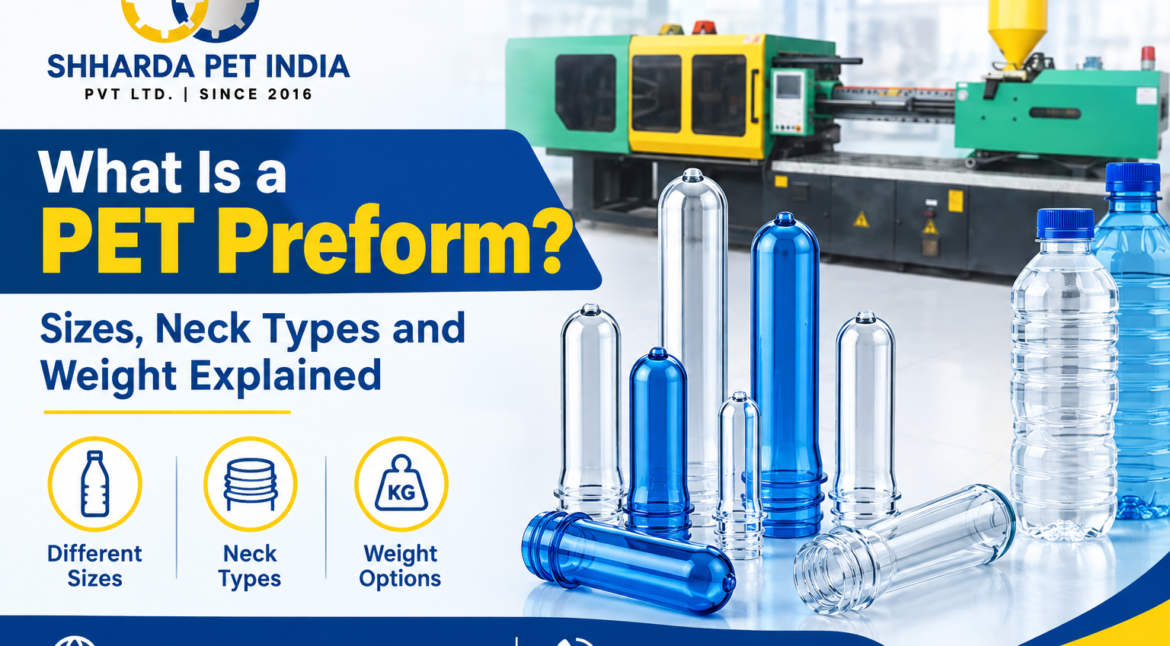
What Is a PET Preform? Sizes, Neck Types and Weight Explained
- Home
- Molding Machine
- What Is a PET Preform? Sizes, Neck Types and Weight Explained
A preform that is 0.1 g overweight looks perfectly fine. Run it through a 96-cavity mould for 8,000 hours a year, though, and that extra 0.1 g adds roughly €31,500 in wasted resin. (That figure comes from SIPA’s worked example: an 11 g preform, a 10-second cycle and resin at €1.2/kg.)
This is why a PET preform is more than a plastic tube you buy before the “real” bottle. Its weight, neck finish and wall distribution decide most of what the finished bottle will be.
This guide is written for production and purchasing managers at water and beverage bottling units. By the end, you should be able to read a preform spec and ask your supplier the right questions.
What Is a PET Preform?

A PET preform is a test-tube-shaped intermediate product. It is injection-moulded from polyethylene terephthalate (PET) resin and later blown into a container for water, soft drinks, milk, alcohol, oils, detergents or personal care products.
Two parts of the preform matter most:
- The neck finish. It is pre-threaded and does not change during blow moulding. It decides which cap fits.
- The tubular body. It is reheated and stretch-blown into the final bottle shape.
In plain terms, the neck is final the day the preform leaves the mould. The body is only a starting point.
That is also the difference between a PET bottle preform and a bottle. The preform is small, dense and easy to stack. The bottle is the same material after heating, stretching and blowing.
How a PET Preform Is Made, Step by Step
PET arrives as small transparent or milky-white pellets, about the size of rice grains. The pellets go through a line of dryers, injection moulding machines, steel moulds and cooling systems. Here is what happens, in order:
- Dry the pellets. Moisture is removed first. Wet resin does not melt cleanly, so this step comes before everything else.
- Melt the resin. The injection moulding machine heats the dried pellets into a smooth liquid. The resin has to flow evenly, or the preform will form with defects.
- Inject into the mould. The molten PET is pushed under high pressure into a steel mould. The hollow space inside, called the cavity, shapes both the tube body and the threaded neck.
- Cool and solidify. Small water channels inside the mould cool the resin fast. It hardens into a solid preform, and this quick cooling gives it strength and dimensional accuracy.
Why the Machine and Mould Matter
The machine and mould used by PET preform manufacturers are not a back-office detail. According to SIPA, their technical characteristics determine production speed, product quality, power consumption, process costs and how often maintenance is needed.
When you evaluate a manufacturer’s machine setup, these are the points worth asking about:
- Injection unit: a servo drive and a screw that rotates continuously at low speed.
- Mould design: a wear-proof coating, good neck cooling and reduced maintenance costs.
- Cavity count: moulds are available with up to 144 cavities.
- rPET capability: some injection-compression machines can run up to 100% rPET.
Cavities are also where money quietly leaks. On SIPA’s 96-cavity example, losing a single cavity costs about €690 a month, or €8,200 a year.
PET Preform Neck Types
The neck is the one part of a preform you cannot adjust later. Thread geometry and sealing rings decide whether your cap closes tightly or leaks. Standardized neck finishes such as 28 mm or 38 mm are built to fit common capping systems. Bottlepreform.com lists these neck options on its product range:
Neck type | Diameter | What to know |
PCO 1881 | 28 mm | Weight has been optimised as low as 10 g by at least one supplier |
PCO 1810 | 28 mm | A second 28 mm PCO option |
BPF | 28 mm | Listed as a separate 28 mm neck type |
29/25 and 30/25 | 29 mm and 30 mm | Listed as their own neck categories |
PCO 3830 | 38 mm | Used with 38 mm capping systems |
45 mm, 48 mm, 55 mm | 45 to 55 mm | Larger necks, listed separately |
Wide mouth | Varies | Suppliers pair these with edible oil and condiments |
Do not choose a neck on diameter alone. Ask for the neck drawing and confirm it against your cap before any order is placed.
PET Preform Sizes and Weight in Grams
Preform weight is usually quoted in grams, often written as “gr” or “g”. It is the single number that links your resin cost to your bottle capacity.
Some reference points from the sources:
- A 550 ml water bottle typically uses an 18 to 20 g preform.
- A 28 mm PCO 1881 preform can be optimised to as low as 10 g.
- SIPA’s cost model uses an 11 g preform.
Consistency matters as much as the number itself. Weight differences above 0.2 g between samples can cause uneven walls, weak spots or wasted resin during blow moulding.
Wall thickness distribution works the same way. A good preform keeps the neck rigid while the body stretches smoothly, so the bottle ends up even rather than thin in one spot and heavy in another.
What Weight Errors Cost
SIPA ran the numbers on a 96-cavity mould working a 10-second cycle for 8,000 hours a year:
- 0.1 g too heavy: about €2,620 a month, or €31,500 a year.
- Cycle time 0.3 seconds longer: about €1,900 a month, or €23,000 a year.
- One lost cavity: about €690 a month, or €8,200 a year.
Small numbers, repeated millions of times, become large ones.
Lightweighting: Real Numbers From Real Brands
Lighter preforms are not a theory. SIPA reports that the average weight of a half-litre PET bottle has already fallen by almost 50%.
Two brand examples show the scale:
- San Pellegrino saved about 850,000 lbs of PET a year through lightweighting.
- Coca-Cola saved 650 tons of resin.
The catch is that a lighter bottle still has to protect its contents, hold its shape, and feel solid to the consumer. Less resin is only a win if strength, impermeability, and stability survive the cut.
Choosing a Preform for Water Bottles
For a preform for water bottle production, the checklist is shorter than most people expect. Work through these in order:
- Match the weight to the volume. A 550 ml bottle uses roughly 18 to 20 g.
- Confirm the neck against your cap. A 28 mm neck is the example used in supplier guides for standard water bottles.
- Look at clarity. High transparency shows the product, and pure resin avoids odour and discolouration.
- Check the surface. Scratches, bubbles, or sink marks lower transparency and hurt the look of the finished pack.
Hot-fill liquids are a different case. SIPA notes that hot-fill, asymmetric, stackable and large-capacity containers need preform designs built for them from the start.
How to Check a PET Preform Before You Order
You do not need a lab to catch most problems. These eight checks come from the Bottlepreform.com buyer guide, and most take under a minute per sample:
- Check colour and surface. A good preform looks clear with no streaks or spots, and shows high gloss under light.
- Smell it. A strange odour often points to poor resin or additives, and it can affect food safety.
- Stand it upside down. On a flat table, a stable preform has a symmetrical, precise neck.
- Ask for tolerance data. Length, neck height, and wall thickness should stay within ±0.1 mm.
- Weigh random samples. Differences above 0.2 g are a warning sign.
- Test strength. Squeeze or drop it. It should not crack or bend.
- Look for defects. Scratches, bubbles, and sink marks all count.
- Confirm certifications. Ask for ISO, FDA, or EU 10/2011 documents for food and beverage use.
Conclusion
A PET preform is the injection-moulded starting point for every blown PET bottle. The neck is fixed at this stage, and the weight and wall distribution shape the bottle that follows.
Know your neck type, know your weight in grams, and test samples before bulk orders. A 0.1 g error or a lost cavity is small on one preform and expensive across a year of production.
If you are comparing options for a water or beverage line, you can look through the PET preform range at Shharda PET India and ask for specifications that match your cap and bottle volume.
Frequently asked questions
Get In Touch
Fill all information details to consult with us to get services from us
A preform is the small, test-tube-shaped piece made by injection moulding. A bottle is what you get after the preform is reheated, stretched and blown into a mould. The neck and threads stay the same through that process, so the cap fit is decided at the preform stage.
For a 550 ml water bottle, 18 to 20 g is a typical range. Other volumes use different weights, so ask your supplier for the weight that matches your bottle design. Light preforms exist too: a 28 mm PCO 1881 can be optimised down to 10 g.
28 mm is the neck finish most commonly shown in supplier guides, and 38 mm is another standardised option. The right choice depends on your capping system, so match the neck drawing to your cap before ordering.
Preforms are made on injection moulding machines with steel moulds, plus dryers and cooling systems around them. Some machines use an injection-compression system. SIPA lists features such as a servo-driven injection unit, continuous low-speed screw rotation and moulds with up to 144 cavities.
It depends on the machine and the output you need. SIPA’s moulds go up to 144 cavities, and its cost examples use a 96-cavity mould. More cavities mean more preforms per cycle, but each lost cavity also costs money.
Preforms can be stored for 3 to 6 months without losing performance, according to Bottlepreform.com. They are compact, lighter than finished bottles and easy to stack on pallets, which keeps storage and freight space down.
They can be, but you should ask for proof. Reliable suppliers provide ISO, FDA or EU 10/2011 documentation. Bottlepreform.com also warns about low-grade products that use plasticisers or BPA-containing materials, and recommends virgin PET for food-grade quality.
Weigh random samples, check that size stays within ±0.1 mm, and stand a preform upside down to see whether the neck is symmetrical. Smell it, look for scratches, bubbles and sink marks, and squeeze or drop it to test strength. Then confirm certifications in writing.