


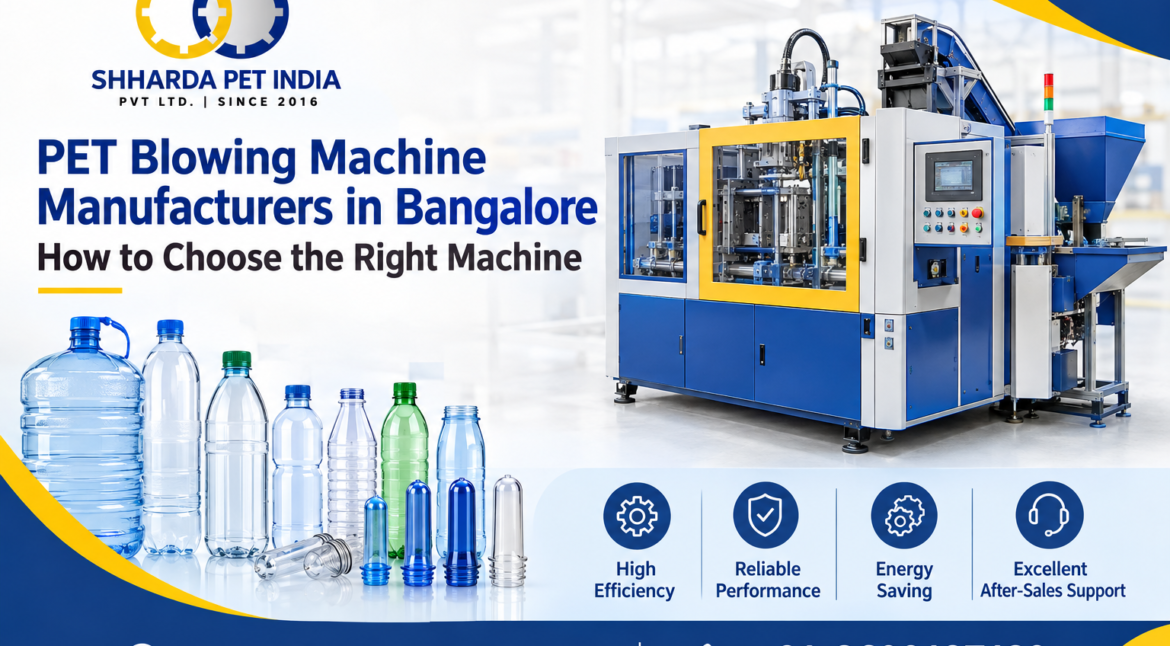
PET Blowing Machine Manufacturers in Bangalore | How to Choose the Right Machine
- Home
- Molding Machine
- PET Blowing Machine Manufacturers in Bangalore | How to Choose the Right Machine
A 2-cavity semi-automatic blowing machine draws about 20 kW while running. A 6-cavity version of the same model draws about 42 kW. That gap shapes your power bill, your floor plan and your output, so it is the first number a Bangalore buyer should look at.
This guide is for plant owners, procurement heads and packaging companies in Bangalore who are comparing PET blowing machine manufacturers. It uses published specifications from Shharda Pet India, a Pune-based manufacturer about 840 km from Bangalore, so you can see what real machine data looks like before you ask anyone for a quote.

What a PET blowing machine actually does
A PET blowing machine turns a small, test-tube-shaped preform into a finished bottle. It heats the preform, stretches it with a rod, and blows high-pressure air inside until the plastic fills a mould.
It does not make the preform, and it does not make the cap. Those come from two other machines, which we cover below. Knowing this early stops you from budgeting for one machine when your line needs three.
Fully automatic vs semi-automatic | which fits your plant?
Both types do the same job. The difference is how much of the loading, moving, and unloading a person handles, and how many bottles you need per hour.
Fully automatic PET bottle blowing machine
A fully automatic PET bottle blowing machine suits plants that run long shifts and need steady, high output. Shharda’s Fully Electric High Speed model uses a continuous rotation system with multiple safety protection devices to keep preform feeding stable at speed.
The company also says 90% of the electrical components are international standard parts, which matters when a sensor fails on a Saturday, and you need a replacement from a local supplier.
Choose this type if:
- You fill beverages or oil at volumes where one stoppage costs a full shift
- You want one operator watching several machines, not feeding one
- You have already proven demand and need to scale
Semi-automatic PET blowing machine
A semi-automatic PET blowing machine costs less to install and suits moderate volumes. Shharda’s Semi Electric Economic range feeds preforms by conveyor, uses a PLC for control, and drives its movements with air cylinders instead of an oil pump, which keeps noise down and avoids oil contamination.
The product page lists 0.6 L, 2 L, 5 L, and 10 L containers, and a capacity of 500 to 5,000 bottles per hour depending on model and mould. It names startups, local beverage makers, and edible oil companies as the typical users.
Here is how the three published configurations compare:
Specification | 2-cavity | 4-cavity | 6-cavity |
Installed power | 50 kW | 72 kW | 104 kW |
Actual power consumption | 20 kW | 29 kW | 42 kW |
Machine size (L x W x H) | 3.1 x 1.45 x 1.85 m | 4.7 x 1.6 x 1.9 m | 7.3 x 2.1 x 2.1 m |
Machine weight | 2.0 T | 4.0 T | 6.35 T |
Chiller water temperature | 10 °C | 10 °C | 10 °C |
Notice that going from 2 to 6 cavities roughly doubles power use but more than triples the weight. If your floor slab or your lift cannot take 6.35 tonnes, the cavity count is decided for you.
Step-by-step: how a preform becomes a bottle
Understanding the sequence helps you ask better questions about each machine.
- Load the preforms. A conveyor or hopper feeds them neck-up into the machine.
- Heat them evenly. In Shharda’s semi-electric design, the preforms rotate on rails inside an infrared preheater so heat reaches all sides.
- Clamp the mould and stretch. A stretch rod pushes the softened preform down to the bottle’s full height.
- Blow with high-pressure air. The published blowing pressure is up to 30 kg/cm² on the 2- and 4-cavity models and 25 to 35 kg/cm² on the 6-cavity model.
- Cool and release. Chilled water at 10 °C sets the shape, then the mould opens and the bottle drops out.
Steps 2 and 4 cause most quality complaints. Uneven heating gives thin walls, and weak air supply gives poorly formed shoulders and bases.
The other two machines on a bottle line
Plastic preform injection moulding machine
If you buy preforms from outside, you pay a supplier’s margin and wait on their schedule. If you make your own, you need a plastic preform injection moulding machine.
Shharda lists preform systems from 280 to 500 tonnes with up to 96 cavities. The company’s M6 range shows clamping forces of 880, 1,280 and 1,680 kN. Its cooling system cools the inner surface of the preform without compressed air, and the cooling stays active for up to 85% of the cycle.
High-speed cap moulding machine
A high-speed cap moulding machine makes closures for the bottles. Shharda’s version uses continuous compression moulding with a rotating design, so caps have no injection point and there is no runner scrap.
Model | Cavities | Output | Actual power |
SPI-C16H | 16 | 11,000 to 13,000 caps/hr | 16 to 20 kW |
SPI-C24H | 24 | 22,000 to 25,000 caps/hr | 25 to 28 kW |
SPI-C36H | 36 | 28,000 to 35,000 caps/hr | 35 to 38 kW |
All three handle caps of 22 to 45 mm diameter and 10 to 25 mm height, in PP, HDPE or LDPE.
Here is what that means over one 8-hour shift. The 16-cavity model makes 88,000 to 104,000 caps. The 36-cavity model makes 224,000 to 280,000. If your bottle line runs at 4,000 bottles an hour, even the smallest cap machine covers it with room to spare.
Three worked examples using published numbers
These are calculations from Shharda’s specification sheets, not customer case studies. Swap in your own figures.
Example 1: Running cost of a 4-cavity semi-electric machine
The 4-cavity model draws 29 kW in actual use. Over an 8-hour shift, that is 232 kWh. At an assumed tariff of ₹8 per unit (check your current BESCOM rate), the blowing machine alone costs about ₹1,856 in electricity per shift, before the compressor and chiller.
Example 2: Sizing for a 5 L edible oil pack
Say you pack 12,000 five-litre bottles a day over 8 hours. That is 1,500 bottles an hour, well inside the 500 to 5,000 range published for the semi-electric series. The 5 L size is on the listed container sizes, so a semi-automatic machine is a sensible starting point, and you would confirm the cavity count with the manufacturer based on cycle time.
Example 3: Matching caps to bottles
Your 2 L water line blows 3,000 bottles an hour, so you need 3,000 caps an hour. The smallest cap machine makes 11,000 to 13,000, which means it would sit idle more than 70% of the time. Buying caps from a supplier, or sharing capacity across several bottle lines, may make more sense than owning the machine.
A buying checklist for Bangalore buyers
Use this before you shortlist any manufacturer, including Shharda.
- Set an hourly target. Work backwards from monthly orders, not from the biggest machine on the brochure.
- List every bottle size and neck size. Each new shape needs its own mould, and the neck decides whether a cap fits.
- Check installed power against actual power. Your electrical connection must cover the installed figure, while the running cost follows the actual figure.
- Plan the utilities. You need a high-pressure compressor, a low-pressure air supply and a chiller. The 6-cavity model’s chiller load is 25,200 kcal/hr at 200 litres per minute.
- Measure your floor and doorway. Add working space around the machine, not only its footprint.
- Ask where spares come from. Standard-brand electrical parts are easier to source than custom ones.
- Ask for a trial run with your preform. Bottle weight, wall thickness, and clarity depend on the preform as much as the machine.
- Get the quote itemised. Separate machine, moulds, chiller, compressor, and installation.
Where Shharda Pet India fits
Shharda Pet India has 8+ years of experience in blow moulding machines and precision blow moulds. The product range covers fully electric high-speed blowing, semi-electric blowing, preform injection, cap moulding and double-station extrusion blow moulding.
The company lists beverages, pharmaceuticals, cosmetics and edible oil among its customer industries. It is based in Dhanori, Pune, so ask about delivery, installation, and service visits to Bangalore before you commit.
Two points are worth raising on a first call. First, ask which parts of the machine use imported or standard-brand components, since the company says 90% of its electrical parts are international standard. Second, ask how moulds are made and who owns the mould design, because a mould you cannot move to another machine ties you to one supplier.
The company also builds a double-station extrusion blow moulding machine in 2 L, 5 L, 10 L and 16 L sizes for PE, PP and PA containers. That is a different process from PET stretch blowing, so it only matters if you also pack products such as lubricants or chemicals in thicker plastic.
Conclusion
Start with your hourly output and bottle sizes, then pick the machine type. Semi-automatic suits moderate volumes and tighter budgets, and fully automatic suits sustained high output.
Check power, weight, utilities, and spares before you compare prices. And remember the line is three machines, not one: blowing, preforms, and caps
Frequently asked questions
Get In Touch
Fill all information details to consult with us to get services from us
Marketplace listings range from a few lakh rupees for basic semi-automatic units to well over ₹15 lakh for fully automatic ones, and high-speed rotary lines cost more. The final figure depends on cavity count, automation level, moulds, and utilities. Shharda Pet India product pages do not list prices, so ask for an itemised quotation based on your bottle size and hourly target.
A fully automatic machine handles preform feeding, blowing, and bottle removal with little operator input, and it targets high output. A semi-automatic machine needs more manual handling but costs less and suits moderate volumes. Shharda lists 500 to 5,000 bottles per hour for its semi-electric range.
Shharda’s Semi Electric Economic range lists 500 to 5,000 bottles per hour, depending on model and mould. Cavity count is the main driver: the range is offered in 2, 4, and 6 cavities. Bottle size also matters, because a 10 L container takes longer to blow and cool than a 0.6 L one.
A preform is a small, thick-walled plastic tube with the bottle’s neck and thread already moulded in. A blowing machine heats and stretches it into the final bottle. The neck never changes shape, which is why neck size must match your caps.
Single-stage machines make the preform and the bottle in one continuous process and are common for cosmetic and pharma packaging. Two-stage setups make preforms on an injection machine first, then reheat and blow them on a separate blowing machine. Most beverage and oil bottlers in India use the two-stage route.
It depends on the model and moulds. Shharda’s semi-electric range lists 0.6 L, 2 L, 5 L, and 10 L containers for carbonated drinks, mineral water, pesticide, cosmetics, and wide-mouth packs. Larger sizes need a bigger machine and higher air pressure, so confirm the maximum container height too.
In Shharda’s published semi-electric specifications, actual power consumption is 20 kW for 2 cavities, 29 kW for 4 cavities, and 42 kW for 6 cavities. Installed power is higher, at 50, 72, and 104 kW. Size your electrical connection for installed power and estimate running cost from actual power.
Yes. Blowing needs high-pressure air, published at up to 30 kg/cm² on Shharda’s smaller semi-electric models, plus a low-pressure supply for machine movements. Chilled water at about 10 °C cools the moulds. Budget for these as part of the line, not as extras.