


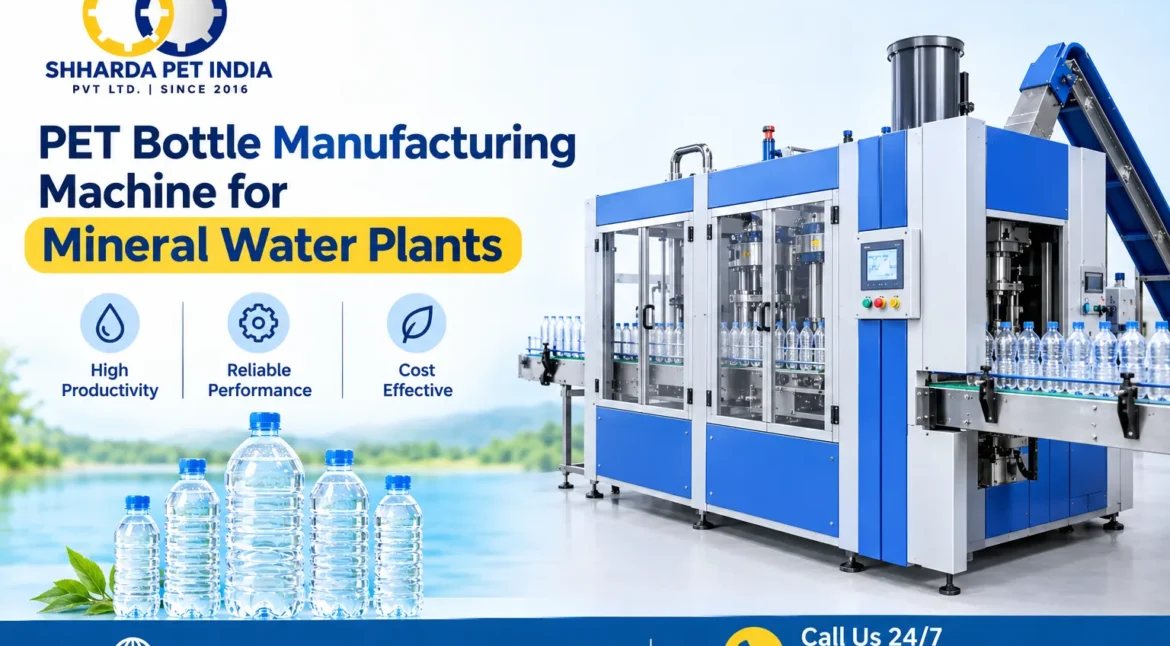
PET Bottle Manufacturing Machine for Mineral Water Plants
- Home
- Molding Machine
- PET Bottle Manufacturing Machine for Mineral Water Plants
Buying bottles from outside sounds easy, until a supplier delays a lot and your filling line sits idle. Many packaged water brands in India now make their own bottles for this reason.
A PET bottle manufacturing machine gives you control over cost, quality, and supply. This guide explains how it works, which type fits your plant, and what to check before you spend.

A PET bottle manufacturing machine turns small plastic preforms into finished bottles using heat, stretching, and compressed air. This process is called stretch blow moulding.
- Mineral water plants usually choose between semi-automatic machines (lower cost, lower output) and fully automatic machines (higher output, lower labour).
- The right pick depends on bottle size, hourly output, power supply, and budget, not on the machine’s price alone.
- India’s PET bottle market was valued at about USD 1.6 billion in 2025, according to IMARC Group, so demand for packaging machinery is not shrinking.
What Is a PET Bottle Manufacturing Machine?
A PET bottle manufacturing machine is the equipment that shapes PET (polyethylene terephthalate) into bottles. PET is the standard material for drinking water because it is clear, light, strong, and food-safe.
Most plants use a two-step process:
- Preform making: PET resin is melted and injected into moulds to form a small test-tube-shaped piece called a preform.
- Bottle blowing: The preform is reheated, stretched with a rod, and blown with high-pressure air into a bottle mould.
The second step is where the blowing machine does its job. You can read more about it on our PET bottle blowing machine price.
How Does a PET Bottle Machine Work? Step by Step
1. Preform loading
Preforms are fed into the machine by hand (semi-automatic) or through a hopper and conveyor (fully automatic).
2. Heating
Infrared lamps heat the preform body evenly. The neck stays cool so the thread keeps its shape. Uneven heating is a common reason for weak or cloudy bottles.
3. Stretching and pre-blowing
A stretch rod pushes the preform downward while low-pressure air begins to expand it.
4. High-pressure blowing
High-pressure air pushes the material against the cooled mould wall. This sets the final bottle shape, including grip rings and base design.
5. Ejection
The finished bottle is released and moves to the next stage, usually rinsing and filling.
Types of PET Bottle Manufacturing Machines
Semi-automatic machines
An operator places the preform in the heater and then moves it to the blowing station.
Best for: startups, small plants, and mixed bottle sizes in low volume.
Trade-off: more manual handling, so output depends partly on the operator.
Fully automatic machines
Preforms are fed, heated, blown, and ejected without manual handling. Rotary and linear designs both exist.
Best for: established brands, high-volume lines, and plants that want stable quality.
Trade-off: higher upfront cost and a need for trained maintenance staff.
Quick comparison
Feature | Semi-Automatic | Fully Automatic |
Labour needed | Higher | Lower |
Output | Moderate | High |
Upfront cost | Lower | Higher |
Consistency | Operator-dependent | High |
Ideal stage | New plant | Scaling plant |
What a Mineral Water Plant Should Look for
Mineral water has tighter hygiene expectations than many other products. Use this checklist when you compare machines.
Bottle size range
Most plants run 200 ml, 500 ml, 1 L and 2 L bottles. Confirm the machine and mould sizes match your product mix. Ask whether changing size means a new mould, and how long changeover takes.
Number of cavities and output
Output per hour depends on the number of cavities (bottles blown per cycle). Ask for the output at your exact bottle size, not a headline figure.
Neck finish compatibility
Your preforms, caps and filling line must share the same neck standard. A mismatch here causes leaks and line stoppages.
Heating system efficiency
Good lamp layout and ventilation save power and reduce rejects. Power is a major running cost, so this matters.
Air supply
Blowing needs a high-pressure air compressor. Check whether it is included, and its capacity, before you plan your utility room.
Safety features
Look for guards, interlocks and emergency stops. This protects operators and supports audits.
Spare parts and service
International-standard electrical parts are easier to source locally. Ask where service engineers are based and how fast they respond.
Where the Machine Fits in the Full Plant Line
A bottle blowing machine is one part of a bigger chain. Here is the usual flow in a mineral water plant:
- Water treatment (RO, UV, ozonation)
- Preform injection (in-house or bought)
- PET bottle blowing
- Rinsing
- Filling and capping
- Labelling and coding
- Shrink wrapping and packing
Blowing machine and filling machine: how they connect
Many buyers look for a PET bottle filling machine manufacturer at the same time as a blowing machine. The two machines should be matched on speed. A blower that makes 6,000 bottles an hour feeds little value into a filler that handles 3,000.
Matching also reduces bottle handling and contamination risk. Some plants link both through an air conveyor.
Making your own preforms
If you want full control, you can add a plastic preform injection moulding machine. This cuts dependence on outside preform suppliers, but needs more space, power and skilled staff.
Caps
Caps are another supply risk. A high-speed cap moulding machine lets you make PP or PE caps in-house.
Finding Manufacturers: Delhi and Beyond
If you search for PET bottle machine manufacturers in Delhi, you will find traders, assemblers, and manufacturers listed together. They are not the same.
Questions to ask any supplier:
- Do you manufacture the machine, or resell it?
- Can I visit your factory or see a running installation?
- Which parts are imported, and which are local?
- Who handles installation, training, and breakdowns?
- What does the warranty cover in writing?
Location matters less than service reach. Shharda Pet India is based in Pune, Maharashtra, and supplies and installs machines across India, including Delhi NCR. Ask any supplier for a client reference near your region.
Costs and Return: What to Plan For
Machine price is only one line in the budget. Plan for these:
- Machine and moulds: moulds are bottle-specific, so each new shape adds cost.
- Air compressor and chiller: needed for blowing and cooling.
- Power: heating and compressed air use significant electricity.
- Raw material: PET resin or preforms is usually the highest running cost.
- Labour: lower with fully automatic lines.
- Maintenance: lamps, seals, and rods wear out over time.
- Compliance: packaged drinking water needs BIS certification and FSSAI licensing.
For exact pricing, ask for a written quotation that lists the machine, moulds, utilities, and installation separately.
Common Mistakes Buyers Make
- Choosing on price only. Rejects and downtime erase the savings.
- Ignoring utilities. Power, air, and cooling must be ready before delivery.
- Buying too small. If you expect growth in a year, choose a machine you can scale.
- Skipping mould planning. Each bottle shape needs its own mould.
- Not matching blower and filler speed. One of them will sit idle.
- No operator training. Skilled handling protects both bottle quality and machine life.
- Overlooking service. A machine is only as good as its support.
Sustainability and rPET
Plastic waste rules and brand pressure are pushing the industry toward lighter bottles and recycled content. In India, Coca-Cola launched a 100% rPET water bottle, as reported by Recycling Magazine, which shows food-grade recycled PET is moving from concept to shelf.
For a plant owner, this means two things: design bottles that use less resin where safe, and check whether your machine and moulds can handle changing preform specifications.
Maintenance Basics
- Clean heating zones and check lamps regularly.
- Inspect stretch rods, seals and valves for wear.
- Keep compressed air clean and dry.
- Cool moulds consistently to avoid cycle variation.
- Keep a small stock of critical spares.
- Schedule annual service visits.
A planned service routine is cheaper than emergency repairs.
Conclusion
A PET bottle manufacturing machine can give a mineral water plant a steadier supply, tighter quality control and lower cost per bottle. The right choice comes down to your bottle size, hourly target, utilities and the quality of after-sales support.
Start with your output goals, match the blower to your filler, plan for utilities early, and compare suppliers on service, not just price.
Frequently asked questions
Get In Touch
Fill all information details to consult with us to get services from us
It is a machine that converts heated PET preforms into finished bottles through stretch blow moulding. It is the core equipment for plants that make their own water bottles.
Semi-automatic suits small startups and lower volumes. Fully automatic suits plants that need consistent quality and higher hourly output. Your daily volume and budget decide it.
Yes, but each size needs its own mould, and some sizes need setting changes. Ask the supplier about changeover time.
Yes. Blowing and filling are separate machines. Match their speeds so neither slows the other.
Buying is simpler and requires less capital. Making them in-house gives more control and can lower long-term costs at high volume, but needs more investment and skill.
Check whether they are true manufacturers, visit running installations, compare written warranties, and ask about service response times.
Plants commonly produce 200 ml, 500 ml, 1 L and 2 L bottles. Larger 20 L jars use different equipment.
Packaged drinking water generally requires BIS certification and an FSSAI licence. Check current requirements with the authorities before you start.