


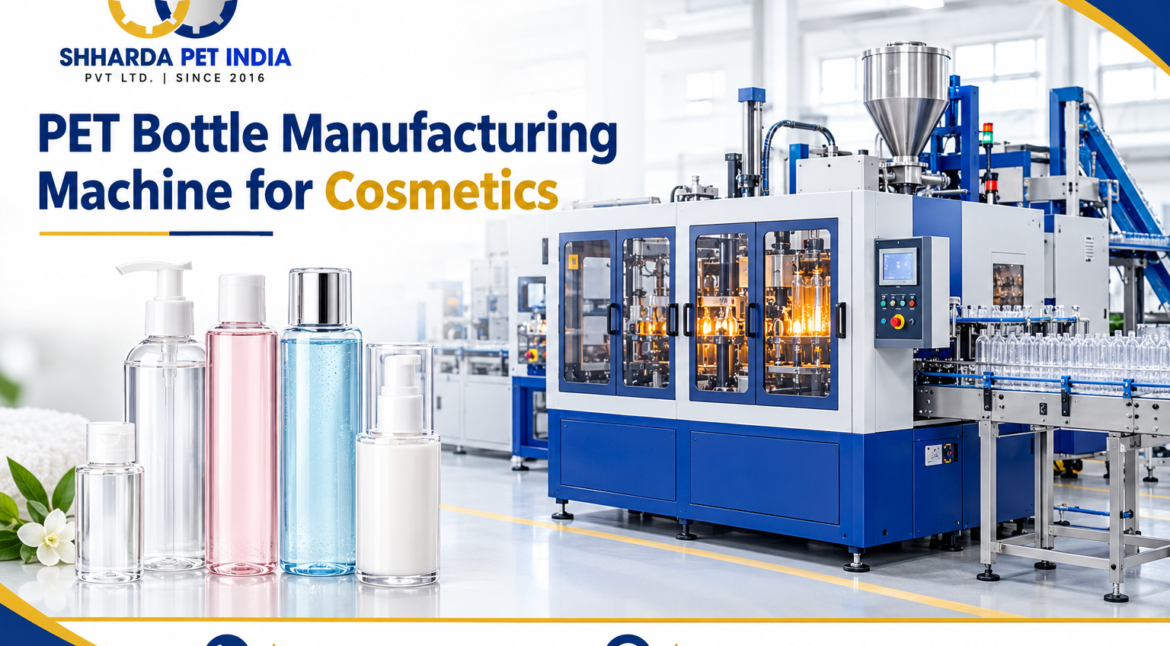
PET Bottle Manufacturing Machine for Cosmetics
- Home
- Molding Machine
- PET Bottle Manufacturing Machine for Cosmetics
You pick up a new toner. The bottle is crystal clear, the neck is smooth, and the pump clicks on perfectly. Nobody thinks about the machine behind it. But if you are launching a skincare line, that machine decides your bottle’s clarity, strength and cost. This guide explains how a PET bottle manufacturing machine for cosmetics works, the two main molding methods, and what to check before you buy one.
What Is a PET Bottle Manufacturing Machine for Cosmetics?

A PET bottle manufacturing machine turns small plastic granules, or ready-made preforms, into finished bottles. Think toner bottles, serum droppers, shampoo containers, lotion bottles and mist sprays.
People call it many things: a bottle-making machine, a cosmetic bottle-making machine, or a PET cosmetic bottle blow molding machine. They all describe the same basic job. Heat the PET, shape it, cool it, and eject a bottle that looks good on a shelf.
Key takeaway: The machine is not just a production tool. It shapes how your brand looks and feels in a customer’s hand.
Why PET Is a Favorite for Cosmetic Packaging
Brands choose PET for good reasons. It is not the only option, but it solves a lot of problems at once.
- Clarity: PET looks close to glass, so colors and textures of your product show through.
- Lightweight: Easier to ship, easier to carry, and gentler on freight costs.
- Strength: Bottles resist cracks and drops better than glass.
- Recyclability: PET is widely recycled, and recycled PET (rPET) is increasingly used in beauty packaging.
- Chemical compatibility: It works well with many water-based and oil-based formulas, though you should always test your own formula.
The Two Main Methods: How Cosmetic Bottles Get Made
There are two molding routes you will hear about again and again. They sound alike, but they behave differently.
Injection Stretch Blow Molding (ISBM)
Injection stretch blow molding is the standard method for PET cosmetic bottles. It works in four steps:
- Injection: Molten PET is injected into a mold to form a test-tube shaped preform. The neck, with its threads, is finished at this stage.
- Conditioning: The preform is brought to the right temperature so it stretches evenly.
- Stretch and blow: A rod stretches the preform lengthwise while compressed air blows it outward into the bottle mold.
- Cooling and ejection: The bottle sets and is released.
The stretching in two directions, called biaxial orientation, is what gives PET bottles their clarity, strength and gloss.
Injection Blow Molding (IBM)
Injection blow molding also starts with an injected preform, but it skips the stretching rod. The preform is simply blown into shape.
This method is common for small bottles and for materials other than standard PET. It gives very accurate necks and no weld lines at the base, which helps with small, precise containers such as sample vials.
The short version: ISBM suits clear, strong PET bottles. IBM suits smaller, precise containers and certain other materials.
One-Step vs Two-Step Machines
Within ISBM, you will also choose between two machine layouts.
One-Step (Single-Stage) Machines
Everything happens in one machine. Granules go in, finished bottles come out.
- Good for custom shapes and small to medium batches
- Better neck accuracy and surface finish, since the preform never cools fully and reheats
- Lower energy use per bottle in many setups
- Easy to switch between designs
Two-Step (Two-Stage) Machines
Preforms are made on a plastic preform injection moulding machine, then reheated and blown on another.
- Better for very high volumes of standard bottles
- Preforms can be bought in or stored, then blown later
- Needs more floor space and more handling
For most cosmetic brands working with unique shapes and moderate runs, one-step machines are the more practical starting point. A large factory making millions of standard bottles may lean the other way.
For very high output, look at a fully electric high speed blowing machine. For smaller runs and tighter budgets, a semi electric economic blowing machine may be the better fit.
Main Parts of a PET Cosmetic Bottle Blow Molding Machine
Knowing the parts helps you ask better questions when talking to suppliers.
- Injection unit: Melts and injects the PET.
- Preform mold: Shapes the preform and the bottle neck.
- Conditioning station: Evens out preform temperature.
- Blow mold: Gives the bottle its final shape and surface.
- Stretch rod and air system: Controls how the preform expands.
- Control system: Often a PLC with a touchscreen to set temperatures, timings and pressures.
- Servo drives: Many modern machines use servo motors for smoother motion and lower power use.
What to Check Before Buying a Bottle Making Machine
This is where many first-time buyers get stuck. Use this checklist.
1. Bottle Size and Shape Range
Cosmetic bottles are often small, from sample sizes to a few hundred milliliters. Confirm the machine handles your volume range and any oval, square or flat shapes you plan to make.
2. Number of Cavities
More cavities mean more bottles per cycle. But more cavities also mean a bigger machine and a bigger mold investment. Match it to your realistic order volume.
3. Neck Finish Accuracy
A pump, dropper or cap must fit perfectly. A poor neck means leaks and wasted product. Ask for samples and test them with your own closures.
4. Bottle Clarity and Finish
Look at the sample bottles under bright light. Check for haze, streaks, bubbles and uneven walls.
5. Material Flexibility
If you plan to use rPET or other resins later, check whether the machine can handle them without major changes.
6. Energy Use and Cycle Time
A faster cycle looks attractive, but only if quality holds. Ask for real figures, not just brochure claims.
7. Mold Quality and Changeover
Molds are a big part of the cost. Ask how long a mold change takes and who supplies replacements.
8. After-Sales Support
Spare parts, installation help and operator training matter as much as the machine itself.
Pro tip: Never judge by price alone. A cheaper machine that produces cloudy or leaky bottles costs far more in the end.
If you are comparing suppliers, Shharda PET India, a Pune-based manufacturer with 8+ years of experience, offers PET bottle blow molding machines for cosmetic packaging. Ask them for sample bottles made on your own design, and test those samples with your closures and formula before you commit.
Common Problems and What Causes Them
Even good machines can produce faulty bottles if settings drift. Here are frequent issues:
- Hazy or cloudy bottles: Often caused by wrong preform temperature or moisture in the PET.
- Uneven wall thickness: Usually a heating or stretching issue.
- Weak bottoms: Can come from poor cooling or incorrect blow pressure.
- Neck leaks: Often linked to mold wear or cooling problems.
- Black specks: Typically contamination or overheated material.
Good operator training solves many of these before they become costly.
Quality and Safety in Cosmetic Packaging
Cosmetics touch skin, so packaging quality is not optional. Bottles should be made in a clean environment, with food-grade or cosmetic-suitable PET.
Regulations differ by country, so check the rules where you sell. Also run compatibility and stability tests with your formula, since some ingredients, like certain fragrances or strong actives, can affect plastic over time.
Trends Shaping Cosmetic Bottle Production
- More recycled content: Brands want rPET and lighter bottles to reduce waste.
- Custom shapes: Unusual silhouettes help products stand out online and on shelves.
- Smaller runs: Indie brands want short, flexible production instead of huge orders.
- Smarter controls: Better sensors and automation cut waste and downtime.
Conclusion
A PET bottle manufacturing machine for cosmetics shapes more than plastic. It shapes clarity, strength, fit and brand feel. Injection stretch blow molding is the go-to for clear PET bottles, while injection blow molding serves small, precise containers.
Before buying, check bottle range, cavities, neck accuracy, finish, material options and support. Test samples with your own formula.
If you want to explore machine options, you can reach out to Shharda PET India, who supply these machines, and discuss your bottle size, shape and volume needs.
Frequently asked questions
Get In Touch
Fill all information details to consult with us to get services from us
Yes, by changing molds. The machine’s maximum bottle volume and tie-bar spacing set the limits.
Neither is better in every case. ISBM is preferred for clear, strong PET bottles. IBM is useful for small, precise containers.
PET is widely used for skincare and personal care packaging. Still, test your own formula for compatibility before launch.
Choose one-step for custom shapes and flexible batches. Choose two-step for very large runs of standard bottles.
Yes, with the right mold. Wide-mouth PET jars for creams and masks are common, but check that the machine handles wide necks and the wall thickness your jar needs.
Both are clear plastics. PET is stiffer and widely recycled. PETG is a modified version that is easier to process and more impact resistant, but it is less common in recycling streams.
Often yes, but quality depends on the rPET grade. Higher rPET content can affect clarity and color, so run trial batches and confirm the machine and your supplier support it.
Cycle times vary by bottle size, wall thickness, cavity count and machine type. Ask suppliers for cycle times on your actual bottle design rather than a general brochure figure.