


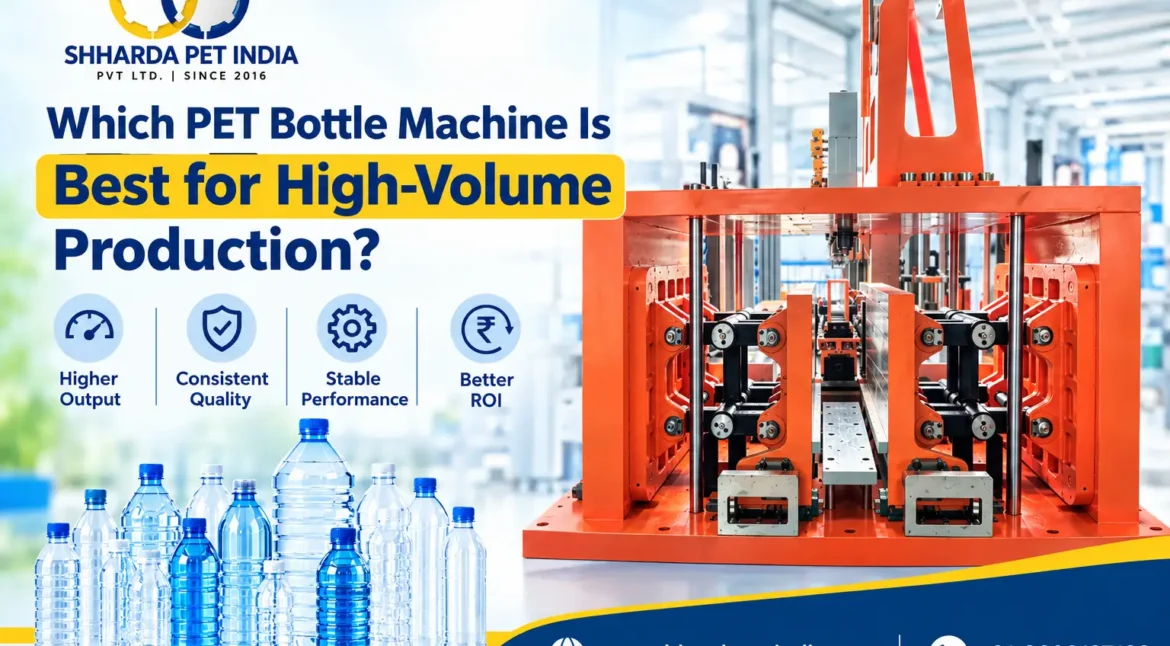
Which PET Bottle Machine Is Best for High-Volume Production?
- Home
- Molding Machine
- Which PET Bottle Machine Is Best for High-Volume Production?
Buy a machine that’s too slow and your filling line waits on bottles. Buy one that’s too big, and you pay for capacity that sits idle.
The right PET bottle machine depends on your output target, bottle design, and budget. This guide explains how the machines work, compares the main types, and gives you a checklist for choosing.
For high-volume production, an automatic rotary PET stretch blow moulding machine is usually the best fit, because its continuous rotation and many cavities deliver the highest output. A multi-cavity linear machine is often more cost-effective for mid-volume plants with several bottle sizes. Semi-automatic machines suit startups and small batches. Always confirm tested output for your own bottle size, and check mould quality, energy use, and after-sales support before you buy.
What Is a PET Bottle Machine?

A PET bottle machine is industrial equipment that turns small test-tube-shaped plastic pieces, called preforms, into finished bottles. The process is called stretch blow moulding.
You’ll see the same equipment sold under several names:
- PET bottle blowing machine
- PET bottle making machine
- PET stretch blow forming machine
- PET stretch blow moulding machine
They all describe one job: heat a preform, stretch it, and blow it into the shape of a mould.
How a PET Stretch Blow Moulding Machine Works
Knowing the process helps you judge machine quality. There are four stages.
- Preform heating. Infrared lamps soften the preform to a precise temperature. Uneven heating causes thin walls and weak bottles.
- Stretching. A rod pushes down inside the preform and stretches it lengthwise.
- Blowing. High-pressure air, usually in a pre-blow and then a main blow, pushes the plastic against the mould walls.
- Cooling and ejection. The finished bottle is released and moves on.
Stretching in two directions at once aligns the PET molecules. That is why PET bottles are clear, light, and strong.
A PET stretch blow moulding machine repeats this cycle thousands of times an hour, so small errors in heating or air pressure add up fast.
The Three Main Types of PET Bottle Blowing Machines
Output ranges below are typical industry figures. Actual speed varies by manufacturer, bottle size, and number of cavities, so ask for a tested figure for your bottle.
Semi-Automatic Machines
You load preforms by hand and the machine blows them.
- Suits startups, trial runs, and small batches
- Low investment
- Output depends on the operator
A semi-automatic blowing machine is not built for high volume, but it is a sensible way to enter the business.
Automatic Linear Machines
Preforms feed in automatically and travel along a straight heating line. Moulds open and close in a set sequence.
- Typically 2 to 8 cavities
- A good fit for mid-volume production
- Easier to maintain, with quicker changeovers between bottle sizes
For many plants, a well-specified linear machine is the best value.
Automatic Rotary Machines
Moulds sit on a rotating wheel, so heating, blowing, and ejection run continuously.
- Many cavities, often 10 or more
- Built for the highest speeds
- Higher cost, larger footprint, and more skilled maintenance
For true high-volume production, rotary machines are the standard choice. Shharda Pet India lists a fully electric high-speed blowing machine with a continuous rotation system, aimed at water, beverage, and pharma bottle production at scale.
Rotary vs Linear: Which Wins for High Volume?
Factor | Linear | Rotary |
Typical output | Mid-range | Very high |
Upfront cost | Lower | Higher |
Changeover | Faster | Slower |
Floor space | Smaller | Larger |
Maintenance skill | Moderate | Advanced |
Best for | Mixed SKUs, growing brands | Continuous, single-SKU runs |
The deciding question is how many bottles you need per hour, every hour.
As a rough guide, if your filling line runs above roughly 10,000 to 12,000 bottles an hour, look at rotary. Below that, a multi-cavity linear machine often does the job at lower cost.
Seven Factors to Check Before You Buy
Brochure output figures don’t tell the full story. Check these seven points.
1. Real Output for Your Bottle Size
A machine rated for 500 ml bottles runs slower with 2-litre bottles. Ask for output data at your bottle volume and neck finish.
2. Number of Cavities
More cavities mean more bottles per cycle. They also need more heating capacity, more air, and tighter process control.
3. Energy and Air Consumption
Heating and high-pressure air are your biggest running costs.
- Ask about energy recovery systems
- Check the air pressure the machine needs
- Compare power use per 1,000 bottles, not just total kW
4. Automation and Controls
Look for a clear touchscreen, saved recipes for each bottle, and fault diagnostics. Good controls cut downtime and operator errors.
5. Build Quality and Spare Parts
A cheap machine that sits idle for two weeks waiting on a part costs more than a pricier one with local support. Ask about spare parts and service response time. Standard electrical components make local sourcing easier.
6. Bottle Quality Features
Check for:
- Even wall thickness
- Consistent neck and base formation
- Support for your needs, such as carbonated drinks, hot-fill, or lightweight bottles
7. Line Integration
The blower should match your filler’s speed. Many high-volume plants use blow-fill blocks or air conveyors between blower and filler. Plan the layout before you order.
Don't Overlook the PET Bottle Mould
Many buyers focus on the machine and treat the PET bottle mould as an afterthought. That is a mistake.
The mould shapes every bottle you sell. Its quality affects:
- Bottle appearance and branding
- Cycle speed, through cooling efficiency
- Defect rates
- How long it lasts before repair
Key mould points:
- Ask what steel or aluminium alloy is used
- Check the cooling channel design
- Confirm mould dimensions match your machine’s clamping system
- Budget for spare moulds if you run several bottle designs
A well-made PET bottle mould can raise output and cut scrap. A poor one drags down even the best machine. If you need a custom bottle shape, discuss mould design with your supplier early.
Preform Quality Matters Too
Your machine can only perform as well as the preform it receives.
- Use preforms with consistent weight and wall thickness
- Store them dry and free of dust
- Match neck finishes to your closures
Inconsistent preforms cause bottles to burst, deform, or fail drop tests, however advanced the machine is.
Some manufacturers make their own preforms to control this. A plastic preform injection moulding machine lets you produce preforms in-house, and a cap moulding machine completes the bottle and closure set.
Common Mistakes Buyers Make
- Buying on speed alone. Peak output means little without stable quality.
- Ignoring changeover time. Frequent bottle changes can erase the gains of a fast rotary machine.
- Skipping a trial run. Test your own preforms and mould before final payment if possible.
- Underestimating utilities. Check compressed air, chilled water, and power supply first.
- Planning for today only. Choose a machine that can handle demand growth over the next three to five years.
Quick Decision Guide
- Starting or testing a product: semi-automatic machine
- Growing brand with several bottle sizes: automatic linear machine
- Large bottler running a few SKUs around the clock: rotary machine
Match the machine to your actual volume and product mix, not the biggest number in a brochure.
Questions to Ask Every Supplier
- What is the tested output for my exact bottle?
- How many cavities, and what is the cycle time?
- What are the energy and air requirements?
- What warranty and spare parts support do you offer?
- Can I see the machine running, or speak to reference customers?
- Is the mould included, and who designs it?
Clear, specific answers are a good sign. Vague ones usually are not.
Explore Machines by Need
- High volume: Fully Electric High Speed Blowing Machine
- Small to mid scale: Semi-Electric Economic Blowing Machine
- Make your own preforms: Plastic Preform Injection Moulding Machine
- Caps: High-Speed Cap Moulding Machine
- Larger containers in PE: Double Station Extrusion Molding Machine
Conclusion
There is no single best PET bottle machine for everyone. For high-volume production, an automatic rotary PET stretch blow moulding machine usually leads on speed. A multi-cavity linear machine often wins on cost and flexibility for mid-volume plants.
Whichever you choose, check the real output for your bottle, energy use, mould quality, preform consistency, and after-sales support. Those details matter more than headline speed.
Frequently asked questions
Get In Touch
Fill all information details to consult with us to get services from us
A PET bottle machine heats plastic preforms, stretches them with a rod, and blows them with high-pressure air into a mould to form finished bottles. It is also called a PET stretch blow moulding machine.
In everyday trade use, they mean the same thing. Both refer to equipment that converts preforms into bottles. Bottle making machine is sometimes used more broadly to include preform and cap machines in a full plant.
An automatic rotary machine is usually best for high volume because it runs continuously with many cavities. A multi-cavity linear machine can be a better choice for mid-volume plants that change bottle sizes often.
It depends on the machine type, number of cavities, and bottle size. Semi-automatic machines produce the least, linear machines sit in the middle, and rotary machines produce the most. Ask the supplier for a tested figure for your bottle.
Yes. Mould cooling design influences cycle time, and mould precision affects defect rates and bottle appearance. A poor mould can slow a fast machine.
Yes. Many businesses begin with a semi-automatic machine to test the market, then move to an automatic machine as demand grows. Plan your preform and mould specifications so they carry over.
Each machine has a maximum bottle volume and neck size range. Changing the size usually means changing the mould and adjusting the settings. Confirm the range before purchase.
Expect to need three-phase power, compressed air at the pressure the machine specifies, and cooling water for moulds. Check each requirement with your supplier before installation.